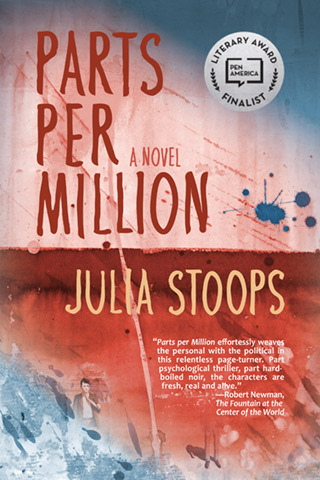
Parts per Million is a novel by Julia Stoops, finalist for the PEN/Bellwether Prize for Socially Engaged Fiction, and published by Forest Avenue Press in 2018.
" . . . urgent and humane"
" . . . a cry for justice and a journey through the heart"
" . . . reads like the bastard offspring of Graham Greene and Naomi Klein"
" . . . one of the origin stories of the resistance, and a primer for the fight to come"
About Parts per Million
Earnest and sensitive John Nelson was compelled to make a real difference in the world, so he abandoned his safe desk job with the Forest Service to join a band of radical environmental and media activists in "Little Beirut" – aka Portland, Oregon. But when he left behind everything he knew to follow his heart, Nelson didn't realize trying to save the world would be so hard.
Against the backdrop of the Bush administration's buildup to the Iraq war, Nelson and his fellow activists Fetzer and Jen investigate war-technologies fraud and corruption at a prominent Portland university. As they close in on the truth, they face escalating danger. Meanwhile, Nelson falls in love with Deirdre, a traveling Irish photographer, but she turns out to be an addict who betrays him.
As the streets of Portland erupt with anti-war protestors, the fraud investigation and the wounded relationship spiral towards a tragic climax that forces Nelson to confront everything he believes in and has sacrificed his “normal” life for. He must transcend his losses and bridge the radical / mainstream divide in order to galvanize his community and transform local politics as we know it.
PARTS PER MILLION is visual and filmic, told over 80 short chapters that alternate between the distinct points of view of Nelson, Fetzer and Jen. It weaves a rich tapestry that explores varying motivations for activism within a contemporary imperative to understand the world from multiple places. Character-driven, yet rich in plot, it sets characters’ personal struggles inside a larger world of social change.
Skip ahead to ordering info »
Advance endorsements for Parts per Million
"Parts per Million effortlessly weaves the personal with the political in this relentless page-turner. Part psychological thriller, part hard-boiled noir, the characters are fresh, real and alive. With a lightness of touch and an uncanny ear for great dialogue, Julia Stoops tells the story of four activists in a time of war, their moral and emotional conflicts, their betrayals and their small acts of heroism. Parts per Million reads like the bastard offspring of Graham Greene and Naomi Klein."
—Robert Newman, author of The Fountain at the Center of the World
"Parts per Million is a cry for justice and a journey through the heart. Julia Stoops brilliantly conjures the social and political unrest of the early 2000s. The war drums, the resistance, the secretive birth of the surveillance state — all lit by deep emotional honesty. Stoops's keen eye sweeps us into the lives of three Portland activists — separate souls shakily united by a cause, a house, and a radiant artist/ex-junkie named Deirdre, who simultaneously illuminates and complicates their struggles. Compelling and deeply compassionate, Parts per Million takes us to a time and place we thought we could forget, but can't, and shouldn't. Reading it may be the surest way to understand who we were then, and—in the tumult of our times — who we need to be today."
—Scott Sparling, author of Wire to Wire
"While Julia Stoops documents activism of the early 2000s, Parts per Million couldn't feel more relevant today. The struggle to remain faithful to the ideals — and hard work — of activism, the thrill of the rare, hard-won victory, and the navigating of personal politics, gives this book a thrilling narrative and makes it an inspired wake-up call to all of our inner activists."
—Ben Parzybok, author of Sherwood Nation
"The little-known history of West Coast, Left Coast eco-activism in the early aughts bursts to life in this timely and important book, full of finely drawn characters and outrageous intrigues. Eco-fiction at its finest, Parts per Million is one of the origin stories of the resistance, and a primer for the fight to come."
—Susan DeFreitas, author of Hot Season
"The page-turning plot would be reason enough to read Parts per Million, but Julia Stoops gives us characters so fully developed the novel feels like theater-in-the-round. Her characters may wear their political hearts on their sleeves, but it's their internal struggles that capture our attention, and make this story such a rich and timely read."
—Stevan Allred, author of A Simplified Map of the Real World
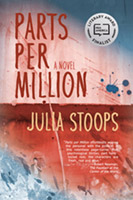
Order Your Copy
Parts per Million is available in many places, but you can support small presses a little extra if you order the paperback or audiobook directly from them:
Order the paperback directly from Forest Avenue Press »
or Indiebound » Get the Audiobook »
And ebooks are available wherever ebooks are sold, including the iBooks app, Google Play and Amazon.
Publicity
• Change of Climate
Wolfson Review by Eva Monhaut • Issue 3, Fall 2023
• Interview: Julia Stoops, Returning to our Authentic Self
Beyond Well Podcast with Shelia Hamilton • Episode 215, 20 minutes, 2022
• Julia Stoops – Author Interview
Writing Through the Body by Johnnie Mazzocco • December 3, 2020
• Radio Interview
KBOO.FM: Between the Covers with Ken Jones
25 minutes • April 23, 2020
• Radio Interview
KBOO.FM: Mr. Jones's Neighborhood with Ken Jones
55 minutes • March 27, 2020
• Podcast Interview
Authors of the Pacific Northwest with Vikki J. Carter
Podcast run time: 1 hour 12 min • November, 2019
• Parts Per Million by Julia Stoops
Necessary Fiction, by Christi Craig • February 04, 2019
• Eco-Fiction at its Finest
Download PDF (scroll to p. 38): Ingenio Magazine • November, 2018
• A Look At Hardcore Activism, Via A Debut Novel By Portland-Area Writer Julia Stoops
Eugene Scene, by Daniel Buckwalter • July 15, 2018
• 5 Oregon Authors …
Books, Tea & Gluten Free by Carmel Breathnach • June 22, 2018
• Review: Parts per Million
IndieLitFic, by Tom Carlisle • June 18, 2018
• Portland Author Julia Stoops
Eleven Magazine, by Morgan Nicholson • June 6, 2018
• Parts per Million: A Review
Cococatani, by Coco d'Hont • May 29, 2018
• In 'Parts Per Million,' Portland author admires, hopes to inspire activism
Oregoninan, by Amy Wang • May 20, 2018
• Riot Recommendation: What's Your Favorite Fiction About Activism?
Book Riot, by María Cristina García Lynch • April 24, 2018
• Radio Interview
XRAY.FM: XRAY In The Morning with Amalia Boyles
Interview is 9 minutes and starts at 1:09 • April 23, 2018
• Q&A with Julia Stoops, author of Parts Per Million
christicraig.com, by Christi Craig • April 18, 2018
• Review: Literary Event of the Week: Parts Per Million
Seattle Review of Books, by Paul Constant • April 9, 2018
• 12 Things to Do and See in Portland: April 2018
Portland Monthly's must-read pick for April (scroll down) • March 27, 2018
• Exclusive Excerpt
The Rumpus, with illustrations by Gabriel Liston (illustrator of Parts per Million) • March 15, 2018
• Review: Parts per Million: A Novel
Small Press Picks, by Beth Castrodale • March 9, 2018
• Review: Powell's Staff Pick
Powell's Books, by Dianah Hughley • March, 2018
• Review, and Book of the Day (April 11, 2018)
Foreword Reviews, by Meg Nola • March 2018
Events
• April 11, 2018
Third Place Books Seward Park, Seattle, WA
• April 23, 2018
Powell's City of Books, Portland, OR
• April 28, 2018
Writers' Night at the Springwater Grange, Estacada, OR
• May 2, 2018
Plonk Reading Series, Corkscrew Wine Bar, Portland, OR
• May 30, 2018
Broadway Books, Portland, OR
• June 26, 2018
Annie Bloom's Books, Portland, OR
• August 19, 2018
Why There Are Words, Portland, OR
• September 18, 2018
Kenton Library: Pageturners Book Club, Portland, OR
• October 16, 2018
Albina Library: Pageturners Book Club, Portland, OR
• November 6
Panelist/Reader, Pacific University Visiting Writers Series, Forest Grove, OR
• November 10, 2018
Portland Book Festival (Formerly Wordstock), Portland, OR. Pop-up reading with Gabriel Liston, Portland, OR
• February 12, 2019
WordFest, Longview, WA
• March 30, 2019
Panelist on "Agents of Change: The Activist Protagonist," at AWP19 Conference, Oregon Convention Center, Portland, OR
Meet The Characters

John Nelson
Nelson's driving motivation is to save the world. He left his wife and his safe desk job with the Forest Service to join this band of activists. But the world hasn't gotten any better since he started trying to save it, and now, at 34, he's full of doubts. His ideals remain strong, but the secrecy and the acts of sabotage have become tiresome. His crisis of meaning is exacerbated by the arrival of Deirdre, a traveling Irish photographer with a hazy past. Maybe Nelson can't save the world, but he's going to try to save fragile, rootless Deirdre, and they fall into an intense, rocky relationship.
As the country gears up for an unwanted war, Deirdre propels Nelson towards tragedy. He must transcend the tensions between idealism and reality and vanquish his doubts in order to be reborn into a new leadership role in his community.

Jen Owens
At 28 Jen is the youngest of the group. She's a sharp and sarcastic hacktivist who thinks Nelson a square and Fetzer paternalistic. She sticks around because without her Nelson and Fetzer would still be printing that pathetic Xeroxed newsletter they started out with.
Jen suspects Deirdre is an undercover federal agent, and lobbies to kick her out. Jen is outvoted, and her subsequent relationship with Deirdre is tainted by her resentment. Anyhow, there are way more important things to think about than some stupid photographer: The Bush administration is reversing environmental protections, threatening war on Iraq, and rolling out the Department of Homeland Security. Quit wasting time, people. There's work to be done.

Irving Fetzer
With his shaved head and black combat boots, Fetzer could be mistaken for a tough guy, but he's really a pussycat underneath. The household's oldest at 49, Fetzer takes it upon himself to be a den mother to the others. Except sometimes his concern is misguided, like when he helps Deirdre keep her drug problem a secret.
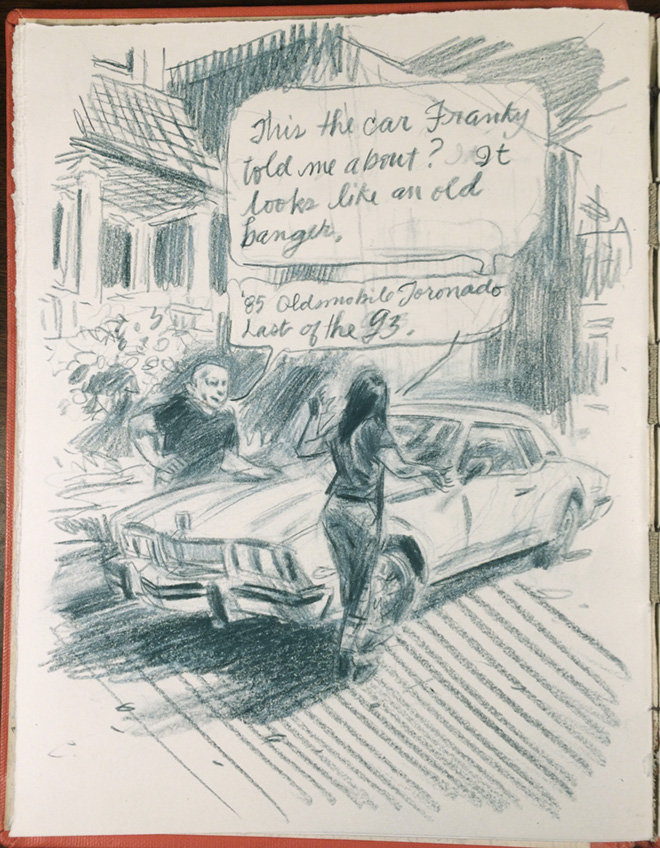
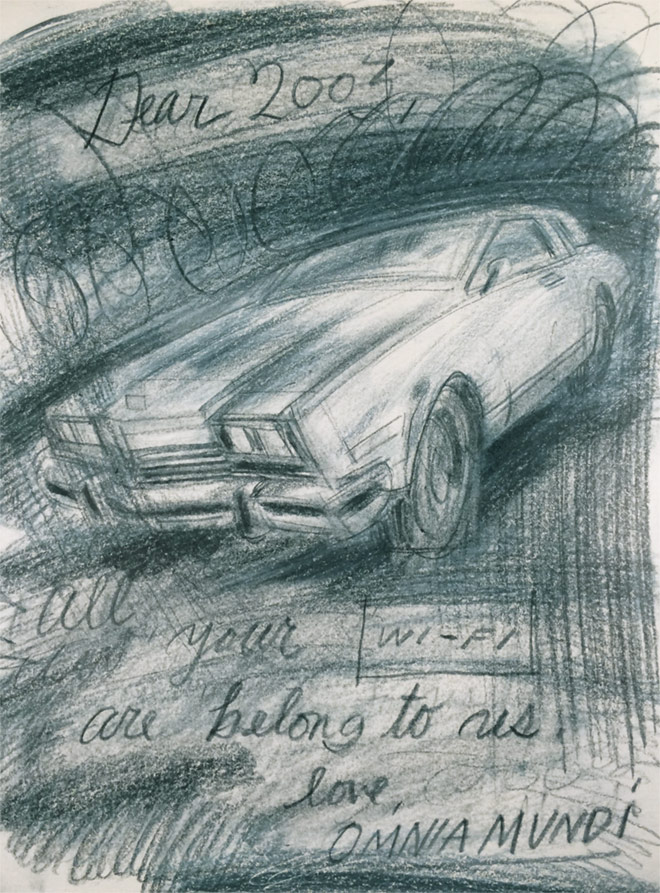
Fetzer is a Vietnam Vet, so his anti-war activism comes from a personal place. He is also the mechanic of the group, and particularly proud of the diesel '85 Oldsmobile Toronado he's converted to biofuel and tricked out with custom electronics. But he's let the paint go dull and he distressed the new head unit to make it look like the old one. No point attracting unnecessary attention.

Deirdre O'Carroll
Deirdre is an Irish photographer traveling the U.S. She lands in Portland and her money and plane ticket get stolen – at least that's what she tells the activists when they let her crash for a night. To Jen's irritation, Deirdre ends up staying. But she's creative and whimsical, and a breath of fresh air during these dark days. She might drink a little too much, but she and Nelson fall in love, and Fetzer is relieved to see Nelson happy. Even irascible Jen is eventually won over by Deirdre's cooking.
Deirdre settles in to her new life with the activists, and takes photographs of the household. These become a body of work in an exhibition at the same university the activists are investigating for war technologies R&D corruption. When the university makes the connection, they're not at all happy, and the blowback triggers a cascade of events that tip Deirdre over the edge and the household into chaos, with powerful consequences for all.
Photo Gallery
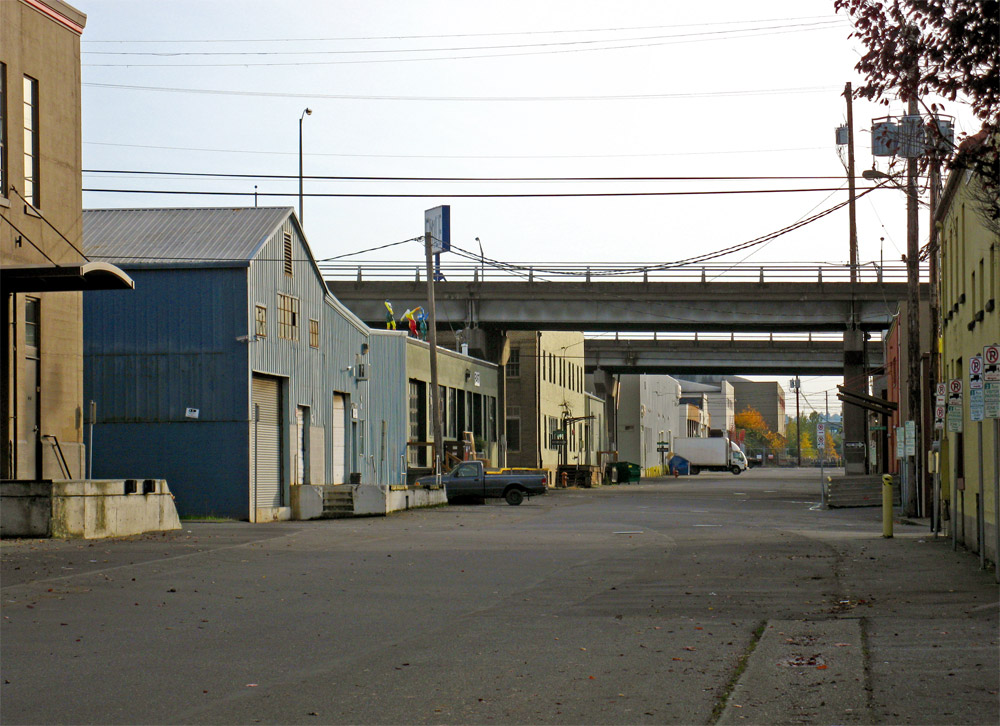
GALLERY 1: The Setting
Parts per Million is set in Portland, Oregon. When they’re not traveling, the activists Nelson, Jen and Fetzer live and work out of a dilapidated old duplex, one of the few houses left standing in their industrial inner Southeast neighborhood.








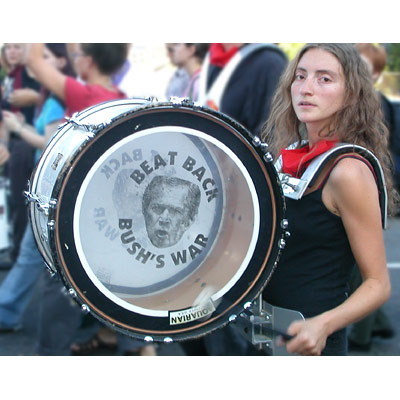
GALLERY 2: The Protests
The buildup to the invasion of Iraq saw Portlanders take to the streets. Many of the street scenes in the story are influenced by real events, but not all the photos here are Julia's. Some were gathered from Indymedia and other sources at the time.

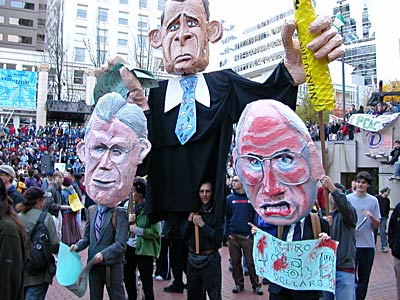

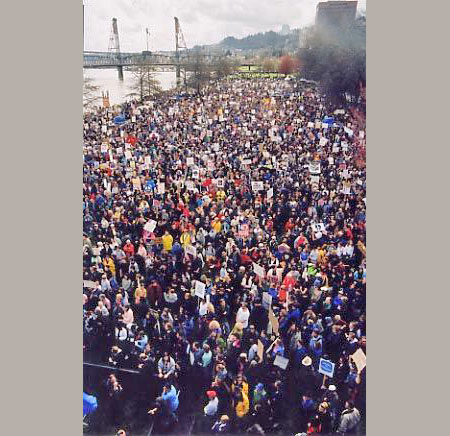
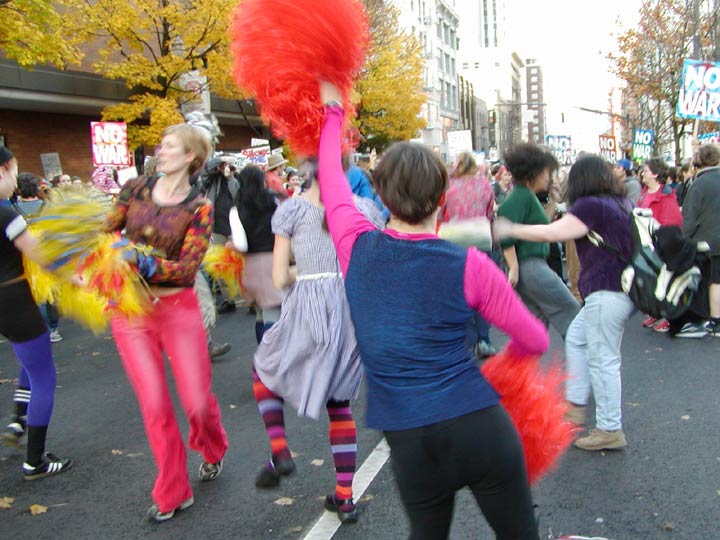


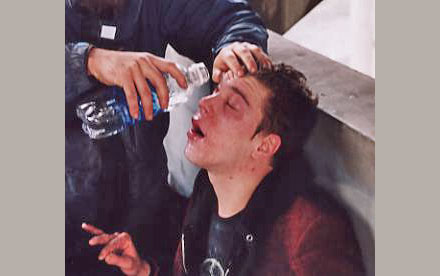


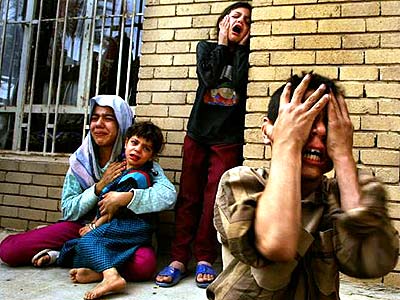
GALLERY 3: The Dissident Art
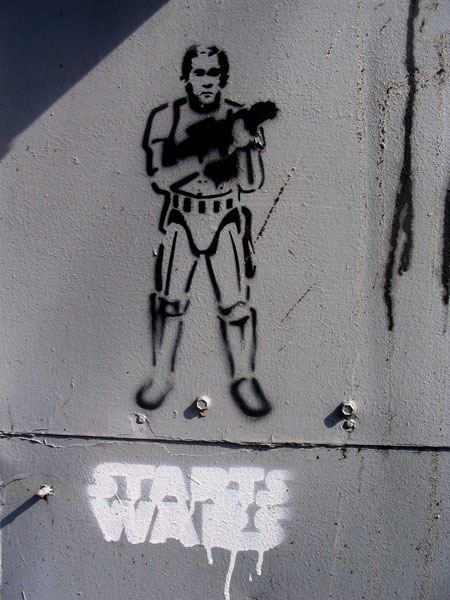
Artistic expression became an outlet for the feelings some people had about the Bush administration. None of these images are Julia's, they are just gathered from that time.












FAQs
How much of your novel is fact and how much is fiction?
The characters are entirely fictional, as are their activities. The university they investigate is fictional too, an amalgam of local institutions.
The inner SE industrial neighborhood the characters live in is real, but some streets are "fudged" for the sake of narrative flow. The characters live on Novi St, which is a fictional street between Ivon and Clinton.
The characters' radio show is fictional but is not unlike something you might hear on KBOO FM, Portland's community radio station.
Every word the characters read in a newspaper or hear on the TV is verbatim from news reports during the fall of 2002 and winter/spring of 2003. However, the source was sometimes changed for aesthetic reasons: e.g. to avoid repetition of sources. The one exception is the report of the Maryville firebombing heard on the car radio in chapter 2. That is entirely fictional.
The descriptions of rallies and protests are closely based on my experiences. (Indeed, they did pepperspray babies at the Bush protest in August '02. You can see a picture of the family in distress in the photo gallery.) The exception is the M20 protest the day after Iraq was invaded. I had to work that night and so gathered anecdotes and notes from others to flesh out that scene.
Why is Parts per Million told from three points of view?
The first draft of the novel was written in omniscient 3rd person, then as I explored deeper I became committed to writing in character voice for several reasons.
First of all, as a writer it's challenging and liberating to remove yourself as the authorial voice and speak as another character. It forces you to reconsider every single sentence.
Secondly, I'm attracted to the narrative device of building a picture using incomplete, and sometimes unreliable or conflicting accounts. As a reader I like to be engaged in sorting it all out and deciding what to believe and what to doubt, so it was natural to explore that device in my own writing.
Thirdly, there's something democratic about telling a story from more than one point of view. It's a way of working with the idea that there is no single "right" perspective. No person's account can carry more authority than another's, and although we share a tremendous amount of experience, our subjectivity is the place where existential questions get interesting.
Why are Nelson‘s chapters in 3rd person, when the Jen’s and Fetzer’s are in 1st person?
Each character's formal point of view choice relates to their personality. Jen is impulsive, angry, and quick, so we get her in 1st person present, in "real time", so to speak. Fetzer is the oldest and wisest, and he has processed the events of the story. Thus his version of the narrative is retrospective, in 1st person past. Of all the characters Nelson knows himself the least. Giving him a 3rd person present voice was a way of adding a little bit of distance, or disconnect, to his version of the narrative.
Why doesn't Deirdre have a point of view?
In earlier drafts Deirdre did have a point of view. But her backstory and interior drama was so big that it dominated the story. And the main arc of the story is Nelson's. Deirdre's purpose as a character is to wring him out and change him. It wasn't appropriate for her to upstage him.
Why did you write about that particular time and place?
The height of the Bush administration was an absurd, fascinating, propaganda-filled, scary time in American history. As I was living through it I felt compelled to record the experience.
Portland was a hotbed of anti-war activism. Eager to support an alternative to the mainstream media, I dove into community news radio. There was so much to say about what was happening in our society. Americans were being manipulated into believing a false case for war and accepting new fascist institutions such as Homeland Security, Operation TIPS and Total Information Awareness. And ordinary people really were being thrown out of shopping malls for wearing Peace t-shirts, and being questioned by authorities for requesting non-flag stamps at the post office. Meanwhile hundreds of Muslim men were arrested and detained indefinitely. There was never a slow news day for alternative media workers.
But after a while I became frustrated because my work in alternative news felt like preaching to the choir. Fiction, because it has entertainment value and has lasting power (compared with a news story), seemed like a good alternative tactic, a way to give voice to a point of view that was being shut out of the conversation.
It was a crazy, messed up time, and I wanted to depict that time through complex characters as they grappled with the everyday experience of absurdity and anxiety.
Is your novel more character driven, or more plot driven?
I don't believe this polarity is necessary, and I strove to balance the two aspects. The characters are intimately drawn, react in nuanced ways, suffer the consequences of their own and others' decisions, and experience growth and evolution. And their activist work puts them in danger and creates external situations and internal tensions they must grapple with. All this against a backdrop of real events in recent history.
About the Author
Julia Stoops was born in Samoa and grew up in Japan, Australia, New Zealand and Washington, D.C. She is a native of New Zealand and has lived in the USA for over 28 years.

Julia is an alum of Portland's Pinewood Table writing critique group. A visual artist as well as a writer, Julia Stoops is a recipient of Oregon Arts Commission Fellowships for visual arts and literature, and was a resident at the Ucross Foundation in 2016. She holds dual degrees in Visual Art and Philosophy, and she received an MFA in Painting from Portland State University. She has experience in alternative radio news journalism and anti-war activism, as well as a background teaching media studies, hybrid art methodologies, and history of ideas. She is married and lives in Portland, Oregon, a city for which she holds great affection.
Contact
Follow Julia
Parts per Million on Goodreads »
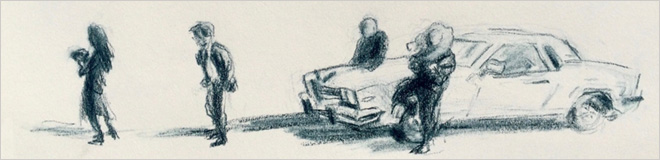
Parts per Million features original illustrations by Gabriel Liston »
Illustrations on this site are from Gabriel's studies for the drawings in the book.
Gabriel filled two big sketchbooks with studies for the book and the companion volume zine of deleted scenes. Check out a gallery of sketches and studies at OmniaMundi.org »
Book cover design by Gigi Little
Book cover art by Julia Stoops
Background art on this site by Julia Stoops, from The 2001 Book »